
Auto-Folding Lightweight Scooter 24kg
A practical mobility scooter offering folds for transport, best matched to how and where you will use it, held back mainly by the lifting weight some users will find heavy.
Knowing where you can ride a mobility scooter and the rules that apply keeps you safe and legal. This guide explains the UK rules for pavements and roads in plain English.
Class 2 (4mph) scooters are for pavements and shops and must not be used on the road except to cross or where there is no pavement. Class 3 (8mph) scooters can be used on the road (not motorways) and must drop to 4mph on pavements, with lights, indicators and DVLA registration. Riders of both must be 14 or over, and pedestrians always have priority on pavements.
Both classes can use pavements, where you must travel at no more than 4mph and give way to pedestrians, who always have priority. Ride considerately, especially in busy areas, and use dropped kerbs to cross. A Class 3 scooter must switch to its 4mph limit on the pavement. Pavements are the natural home for Class 2 scooters and for careful local travel.
Only Class 3 scooters may be used on the road, following the rules of the road as other vehicles do, with lights and indicators in use as needed. They cannot use motorways, and should avoid fast dual carriageways where possible (and use an amber flashing light if they do). Class 2 scooters should only be on the road to cross or where no pavement exists, and should take care and be visible.
Class 3 scooters must be registered with the DVLA before road use (free, no road tax or test). Both classes require the rider to be 14 or over. Neither needs a driving licence or, by law, insurance - though insurance is strongly recommended for both, covering theft, damage and liability. Always check current rules at gov.uk, as this is a summary and rules can change.
Use lights after dark, make yourself visible, give way to pedestrians, and take care at crossings and kerbs. Keep to a safe speed for the conditions and people around you. Many users also fit mirrors and high-visibility accessories. Being considerate on pavements and predictable on roads keeps you and others safe and maintains goodwill toward scooter users.
A practical mobility scooter offering folds for transport, best matched to how and where you will use it, held back mainly by the lifting weight some users will find heavy.

A practical mobility scooter, best matched to how and where you will use it, held back mainly by a few practical limitations.
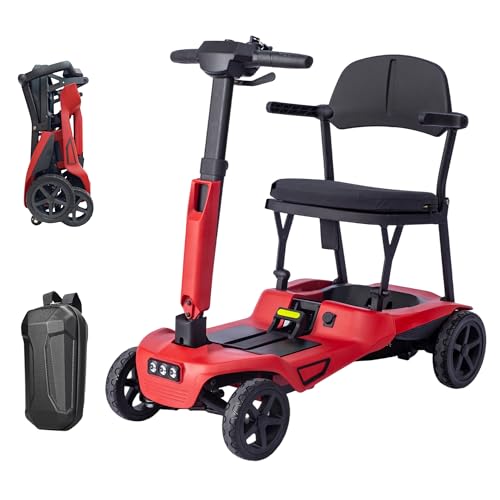
A practical mobility scooter offering range up to 10 miles and folds for transport, best matched to how and where you will use it, held back mainly by the lifting weight some users will find heavy.
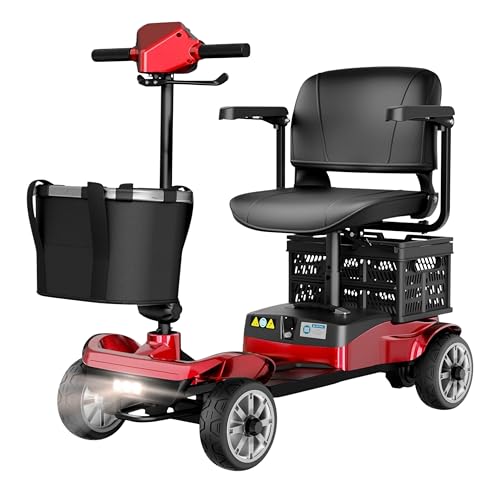
A practical mobility scooter offering range up to 13.75 miles and max user weight 135 kg, best matched to how and where you will use it, held back mainly by a few practical limitations.
Class 2 (4mph) scooters are for pavements and shops, on the road only to cross or where there is no pavement. Class 3 (8mph) scooters can use roads (not motorways) and must drop to 4mph on pavements.
Yes, both classes can use pavements at up to 4mph, giving way to pedestrians who always have priority. A Class 3 scooter must switch to its 4mph limit when on the pavement.
It is not legally required for either class, but it is strongly recommended, covering theft, damage and liability. Class 3 scooters must be registered with the DVLA, though there is no road tax, test or licence requirement.
Our top pick is the Auto-Folding Lightweight Scooter 24kg (our score 9.6/10) - A practical mobility scooter offering folds for transport, best matched to how and where you will use it, held back mainly by the lifting weight some users will find heavy..